Why your tomato tastes like nothing?
Updated: Apr 30
Pick up a tomato from most grocery store shelves today. Hold it. It’s perfectly round. Uniformly red. It can survive being harvested by machine, transported thousands of miles, and remain intact for weeks. It looks exactly like a tomato should look.
Now bite into it.

Nothing. Water with a faint suggestion of something that was once flavor. No sweetness. No brightness. No aroma that rises before you even take the first bite. Just texture and moisture and the ghost of a taste that somewhere, in some other version of this fruit, actually exists.
This isn’t an accident. And it isn’t your imagination. It’s the single most revealing fact about what happened to our food- and understanding why it happened is the beginning of understanding how to fix it.
The Science of a Disappearing Flavor
The food scientist Harry Klee has spent years studying tomato flavor and genetics. His research revealed something that should have been obvious but somehow wasn’t: modern breeding prioritized appearance, durability, and yield so exclusively that flavor compounds were inadvertently bred out. The genes responsible for sugar content, for the volatiles that give tomatoes their aroma, for the acid balance that makes them taste bright and alive- these were lost in the pursuit of other qualities.
“A tomato that looks perfect but tastes like nothing, represents a fundamental misunderstanding of what food is for.” -Harry Klee
But the tomato is only the most visible symptom. The same logic - optimize for what’s measurable and marketable, sacrifice what isn’t - played out across nearly every crop we eat. And to understand why, you have to understand what came before.
How We Got Here

Somewhere in the mid-20th century, food production underwent a transformation that seemed, at the time, like pure progress. The Green Revolution promised to end hunger. Mechanization would free farmers from backbreaking labor. Chemical fertilizers could make anything grow anywhere.
The food historian Rachel Laudan reminds us that for most of human history, food was unreliable, often unsafe, and consumed most of people’s time and income. Mothers lost children to contaminated milk. Families went hungry when harvests failed. The industrial food system solved real problems. It made food cheaper, more consistent, more available.
This matters. The shift toward industrial food wasn’t some conspiracy of corporate greed. It was an attempt, however flawed, to solve genuine human suffering.
But as often happens with solutions, new problems emerged that no one had quite anticipated. And the most quietly devastating of those problems was this: we stopped growing food that tasted like anything.
The writer and farmer Dan Barber describes visiting a conventional wheat farm where the farmer admitted, with neither shame nor pride, that he’d never tasted his own wheat. “I grow it for yield,” he explained. “What it tastes like doesn’t matter.” The wheat went to industrial mills that would blend hundreds of varieties together, stripping away the germ and bran, turning something alive into something shelf-stable.
This wasn’t cruelty. It wasn’t even thoughtlessness. It was optimization. But optimization for the wrong things: appearance over flavor, shelf-life over nutrition, yield over soil health, efficiency over relationship.
The Disappearing World of Taste
The tomato’s story is not unique. It’s everywhere, in everything.
The chef and writer Matt Goulding, documenting rice culture across Asia, describes tasting traditional varieties that had nearly disappeared. Some were nutty. Some were floral. Some had a texture that was almost creamy, others with a chew that made each grain distinct. “The rice we eat today,” he wrote, “is to these varieties what instant coffee is to a perfectly pulled espresso. It serves a function, but it’s lost something essential in the process.”
The agricultural scientist Debal Deb documented this collapse across India. Locally adapted crops- the kunde soppu that grows abundantly without intervention, the mundigai that thrives without chemicals and provides leaves, flowers, and pods throughout the year - get sidelined in favor of vegetables that photograph better but offer less nutrition. What looks good and what tastes good, what actually nourishes- the market has little interest in the difference.
In 1970, Indian farmers cultivated approximately 400,000 varieties of rice. By 2000, more than 90% had disappeared, replaced by a handful of high-yielding varieties. Each lost variety represented generations of farmers selecting seeds for specific qualities: drought tolerance, flood resistance, particular flavors, nutritional density.
The United Nations Food and Agriculture Organization estimates that 75% of agricultural diversity was lost during the 20th century. We optimized for uniformity, and lost not just resilience- but flavor, complexity, and the entire sensory landscape of eating.
The Soil Beneath the Taste
But why does a tomato taste like nothing? The answer isn’t only in the seed. It’s in the ground the seed grows in.
The agricultural journalist P. Sainath has documented this trap for decades across India. Farmers are locked into purchasing hybrid seeds that can’t be saved and replanted, chemical fertilizers, pesticides- costs that climb each year. The soil becomes too depleted to grow anything without them, which means the chemicals can’t stop, which means the debt can’t stop. They’re farming to service debt, not to grow food.

In healthy soil, there’s a universe of life: bacteria, fungi, nematodes, protozoa, all working in intricate relationships to make nutrients available to plants. The soil scientist Elaine Ingham has shown that a single teaspoon of healthy soil contains more organisms than there are people on Earth. But industrial agriculture treats soil as an inert medium for holding plants upright while chemicals provide all nutrition. The result is soil that has lost everything that made it fertile- the softness, the smell of earth after rain, the earthworms, the microbial life. After decades of chemical agriculture, what’s left is hard, dense, and essentially dead.
Dead soil grows tasteless food. The connection isn’t mystical- it’s biochemical. Healthy soil makes a wider range of nutrients and minerals available to plants. Plants grown in living soil develop more complex flavor compounds. The minerality in a carrot, the depth in a tomato, the aromatic complexity in herbs- these come from living soil doing what it evolved to do. Strip the life from the soil, and you strip the life from the food.
This is why your tomato tastes like nothing. It wasn’t grown in dirt that had anything left to give.
The Human Cost
The toll extends far beyond flavor. Between 1995 and 2015, more than 300,000 farmers in India died by suicide- a crisis directly linked to debt from purchasing agricultural inputs they couldn’t afford, for crops whose prices they couldn’t control.
In the United States, the average age of farmers has climbed to 58. Young people are leaving agriculture because the economics don’t work. The writer and farmer Wendell Berry has spent a lifetime documenting the hollowing out of rural communities as industrial agriculture replaced diverse family farms with massive monocultures.
“The industrial economy,” Berry wrote, “is based on consumption. The agrarian economy is based on the preservation and enhancement of life. These are fundamentally different values, and cannot coexist peacefully.”
We built a system that produces enormous quantities of food. But the food tastes like nothing, the farmers growing it are going bankrupt, and the land producing it is dying. These three facts are not separate problems. They are the same problem, seen from different angles.
Seeds of Resistance
But if you listen carefully, you’ll hear different stories emerging. Stories of farmers who’ve chosen a different path, often at significant personal cost- and who are, slowly, bringing flavor back.

In Odisha, a tribal farmer named Kamala Pujari has preserved over a hundred varieties of indigenous rice. While the Green Revolution pushed farmers toward high-yielding hybrids, she quietly continued saving seeds the way her ancestors had- selecting the best grains each harvest, storing them carefully, planting them the next season.
She talks about rice the way some people talk about children- each variety has its own personality, its own needs, its own gifts. There’s rice that grows in drought conditions. Rice that thrives in floods. Rice that tastes nutty. Rice for celebrations, aromatic and special.
“When you only grow one or two types,” she explains, “what happens when the monsoon fails? You lose everything. But when you have many varieties, you have adapted to whatever comes. This is not just farming. This is survival. This is wisdom.”
Debal Deb, who worked with farmers like Kamala Pujari to establish folk rice seed banks, writes: “These farmers aren’t preserving the past. They’re preserving options for an uncertain future.”
The California farmer Mas Masumoto made a similar choice when he decided to keep growing Sun Crest peaches even though they were, by every economic measure, a terrible idea. They bruised easily. They didn’t ship well. But they tasted like peaches were supposed to taste - intensely sweet and floral and complex, the kind of flavor that stops conversation and creates memory.
“I farm flavor,” he wrote. “Everything else is secondary.”
He once received a letter from a woman who remembered eating Sun Crest peaches as a child. She thought that flavor was gone from the world, lost to time and progress. When she discovered he was still growing them, she wept. “You preserved my childhood,” she told him.
A farmer choosing financial difficulty to preserve a flavor. A woman moved to tears by the rediscovery of a taste she thought she’d lost forever. This is what happens when the relationship between grower and eater isn’t mediated purely by price and convenience. Meaning enters the equation. Memory. Care.
The Return to Living Soil
In Andhra Pradesh, farmers practicing Zero Budget Natural Farming describe a transformation that sounds almost miraculous until you understand the science underneath. After years of chemical farming that left their soil depleted and their debts mounting, they learned to make jeevamrutha- a fermented microbial culture using cow dung, cow urine, jaggery, pulse flour, and soil from their own fields.
Farmers who switched describe watching their soil transform over several seasons- softening year by year, the smell returning, earthworms and birds coming back. Costs dropped to almost nothing. Yields eventually matched what they’d gotten with chemicals, but without the debt, without poisoning the land and water. And the vegetables, they say, started tasting like vegetables again.
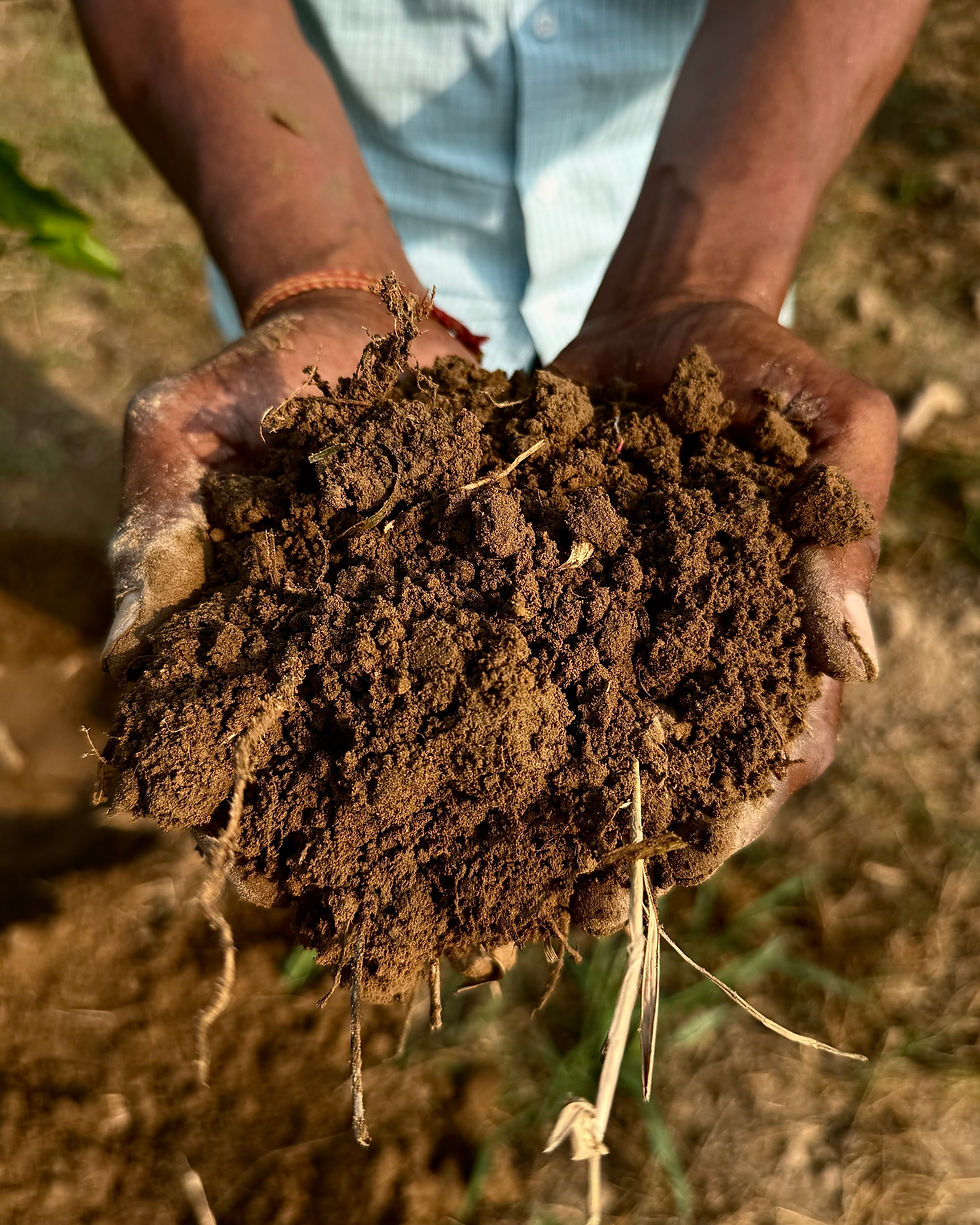
The farmer Gabe Brown in North Dakota followed a similar path. After a series of crop failures forced him to question conventional methods, he began experimenting with cover crops and diverse rotations. His soil organic matter increased from less than 2% to more than 6%.
“I didn’t set out to be a revolutionary,” Brown says. “I just wanted to stop losing money. But what I discovered was that when you work with nature instead of against it, everything changes. The soil holds more water. Plants resist pests better. Flavor improves. And your costs drop dramatically.”
Chef Dan Barber describes tasting a carrot grown by a farmer who’d spent years rebuilding his soil. “It tasted like a carrot. I know that sounds strange, but most carrots today don’t taste particularly like anything. This one was sweet, earthy, and complex. It tasted like the soil it grew in, like the care that went into growing it. It tasted honest.”
That’s what living soil gives back. Not just yield. Flavor. Honesty. The taste of a place, a season, a relationship between earth and plant that took millennia to develop and only decades to destroy.
When Your Tomato Is Supposed to Taste Like Something
Part of why your tomato tastes like nothing is when you’re eating it. If it’s January and you’re biting into a tomato that was picked green in another hemisphere and ripened with ethylene gas during shipping, you’re not eating a tomato. You’re eating a simulation of one.

The Japanese have a concept- shun- that refers to the peak moment when a food is at its absolute best, when the season and the ingredient align in brief, perfect harmony. It’s a word that implies attention, knowledge, and patience. It’s also a word that makes almost no sense in a food system where strawberries are available year-round and where “seasonal” has become a marketing term rather than a lived constraint.
The food writer Tamar Adler writes about seasonality as a form of attention. “When you eat seasonally, you’re paying attention to the world. You’re noticing what’s changing, what’s arriving, what’s departing. Food becomes a way of marking time, of being present to the year’s turning.”
Once you start thinking this way, out-of-season produce starts to feel fundamentally wrong- not just less flavorful, but like eating something that doesn’t want to be eaten yet, forced to exist in conditions it wasn’t meant for.
A tomato in August, grown in good soil, picked ripe, eaten within days of harvest- that tomato tastes like a tomato. The one in your grocery store in February is something else entirely. Same name. Entirely different experience.
What Can Be Done
The changes happening in food systems aren’t coming from governments or corporations. They’re coming from individuals and small groups making different choices- farmers, chefs, eaters- and building networks of mutual support. Farmers’ markets. CSAs. Direct relationships between growers and kitchens. Each one a small closing of the loop between the people who grow food and the people who eat it.
For home cooks, the changes can be simpler but no less meaningful. Shopping at farmers’ markets when possible. Joining a CSA. Learning to cook seasonally, to preserve abundance, to use whole ingredients. Accepting that tomatoes taste best in summer, that winter has different gifts, that some waiting makes the eventual arrival more delicious.
“Learn to cook from what you have rather than shopping for specific recipes. If you see beautiful eggplant at the market, buy it and figure out what to do with it later. This is how people cooked for most of human history- responding to what was available rather than demanding the world provide specific ingredients on demand.” -Tamar Adler
The Taste of Care
There’s a moment that happens when you taste food grown with real care, cooked with attention, served with knowledge of its origins. It’s not always dramatic- not every tomato will bring you to tears. But there’s a recognition, a sense of rightness, a pleasure that goes beyond just flavor.
Picture: Green Giant, Green Doctor and San Marzano Tomatoes at Meld Farms
“It seems to me that our three basic needs, for food and security and love, are so mixed and mingled and entwined that we cannot straightly think of one without the others.” -M.F.K. Fisher
This is what the industrial food system failed to understand: that food is never just food. It's a relationship. It’s culture. It's a memory. It's a connection to place and season and the people who grow it. When we reduce it to mere fuel or commodity, we lose something essential to being human. And the first place we notice that loss- the place it announces itself most clearly- is in flavor. In the tomato that tastes like water. In the peach that tastes like nothing at all.
What’s emerging now isn’t a rejection of knowledge or technology, but a reorientation of what we optimize for. Not just yield, but soil health. Not just appearance, but flavor and nutrition. Not just efficiency, but resilience and relationship. These aren’t just ethical preferences - they’re practical necessities for a food system that can sustain itself over generations rather than decades.
The invitation is simple: eat with more awareness, more gratitude, more attention. Support the farmers doing the hard work of rebuilding soil and preserving diversity. Cook with the seasons. Value flavor and nutrition over appearance and convenience. Not because it’s morally superior- but because it’s more pleasurable, more interesting, more connected to the actual world we live in. Because tomatoes that taste like tomatoes are better than tomatoes that taste like nothing.
The farmers are already doing the work. The soil is ready to come back to life, if given the chance. The seeds are being saved, the techniques preserved and refined, the relationships rebuilt.
The only question is whether we’re ready to pay attention.
There’s a video of a Japanese farmer named Takao Furuno standing in his rice paddy, explaining something extraordinary. He doesn’t use pesticides. He doesn’t use herbicides. Instead, he introduced ducks into his rice fields. The ducks eat the pests, their droppings fertilize the soil, their movement aerates the water. “The ducks are my employees,” he says with a smile that suggests he finds the whole thing rather obvious. “And they work for food.”
What makes the video remarkable isn’t the ingenuity. It’s the farmer’s face as he talks about his relationship with the land, the ducks, the rice. There’s a tenderness there, the kind that comes from spending decades learning something deeply. No performance. No attempt to sell anything. Just a person who has discovered how to work with nature rather than against it, offering what he knows with the quiet generosity of someone sharing a recipe handed down through generations.
The next time you encounter a misshapen tomato, a chef’s note about changing the menu based on what arrived from the farm that morning, or a jar of something fermented with more care than speed - pause. Someone is trying to feed you honestly. Someone is choosing relationship over efficiency. That choice deserves to be noticed, tasted, valued.
References:
Adler, Tamar. An Everlasting Meal: Cooking with Economy and Grace. Scribner, 2011.
Barber, Dan. The Third Plate: Field Notes on the Future of Food. Penguin Press, 2014.
Berry, Wendell. The Unsettling of America: Culture & Agriculture. Sierra Club Books, 1977.
Brown, Gabe. Dirt to Soil: One Family’s Journey into Regenerative Agriculture. Chelsea Green Publishing, 2018.
Deb, Debal. Seeds of Tradition, Seeds of Future: Folk Rice Varieties of Eastern India. DRCSC and Vrihi, 2005.
FAO (Food and Agriculture Organization). “The State of the World’s Biodiversity for Food and Agriculture.” 2019.
Fisher, M.F.K. The Art of Eating. Wiley Publishing, 1954.
Goulding, Matt. Rice, Noodle, Fish: Deep Travels Through Japan’s Food Culture.Ecco, 2015.
Ingham, Elaine. Various publications on soil microbiology and soil food web.
Sainath, P. Everybody Was, and Nobody Is. Various long-form reporting on Indian agricultural crisis, 1990s–2010s.
Comments